
H1 2026 Performance Update: Getting Worse Before Getting Better

Welcome to the first half 2026 performance update letter of Interconnected Capital.
To new and old readers alike, a friendly reminder: I run a global technology long-only fund focused on investing in both the hardware and software “picks and shovels” of the interconnected global digital AI economy. I draw on my technology business operator’s experience and geopolitical antennas to bring an edge to how I assess a tech company’s rhythm and prospects in a constantly changing world. [0]
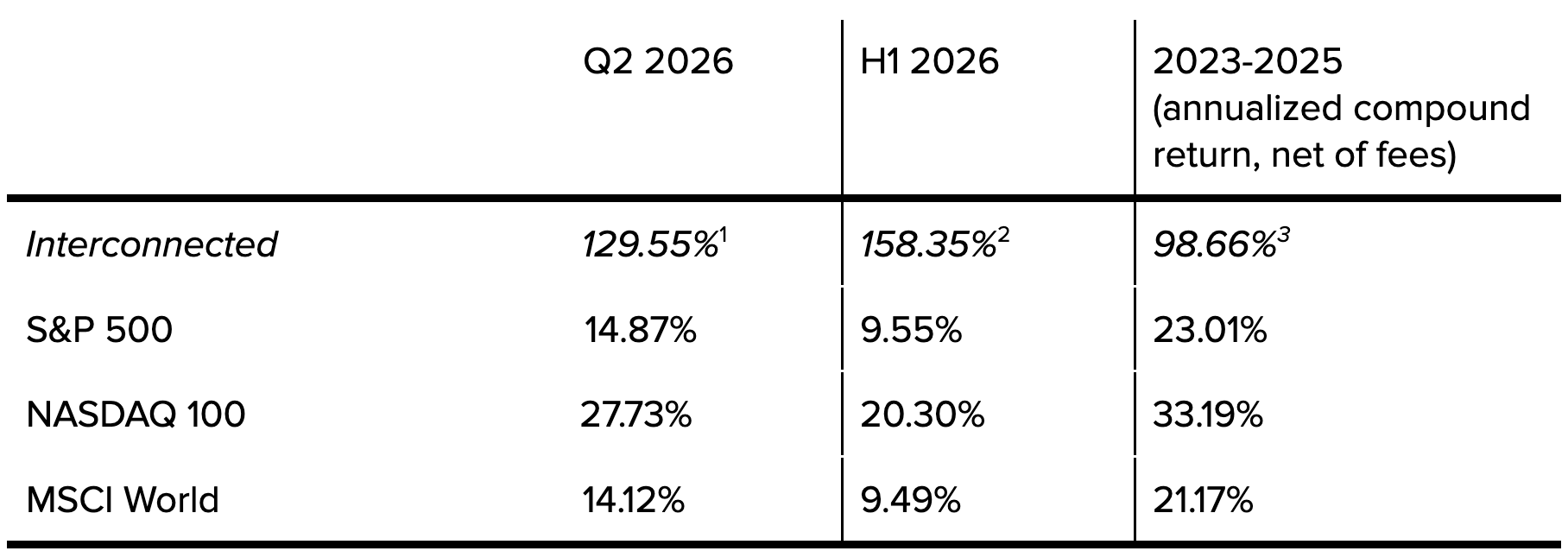
As always, first the numbers, then the commentaries and outlook.
[0] My past experiences include: senior leadership position at GitHub (the world’s largest developer and open source technology platform, now owned by Microsoft), a unicorn database startup, early stage VC, and the White House and Department of Commerce during the Obama administration. I studied law and computer science at Stanford; international relations at Brown.
[1] Includes April 1 - June 30, 2026, gross returns. Unaudited.
[2] Includes January 1 - June 30, 2026, gross returns. Unaudited.
[3] Net of fees. Audited.
Portfolio positions in random order (as of June 30, 2026):
OUSTER INC
INTEL CORP
APPLIED MATERIALS INC
CIENA CORP
APPLIED MATERIALS INC (Puts)
NEBIUS GROUP NV
ARM HOLDINGS PLC-ADR (Puts)
Building off of our Q1 success, Q2 was an extraordinary quarter from a performance perspective. It was unnatural. It was unnerving. And it has happened once before, even in the short lifespan of Interconnected Capital. For those of you who have been tracking, our Q3 2025 performance also effectively doubled the fund. Subsequently, we experienced a somewhat steep drawdown in Q4 2025, even though we still ended the year close to doubling the portfolio on a gross basis.
As much as I would like to celebrate the first half’s score, my mind is already focused on avoiding a similar drawdown. What goes up must come down. But what goes up a lot, if properly risk managed, does not have to come down a lot. I’m structuring the portfolio differently this time. The positions are more balanced in general. I have some hedges in place in the form of put options, something I said I would do earlier this year. And we are sitting on a healthy dose of cash.
Having cash does not mean I won’t be looking for ways to deploy. Opportunities still exist. I’m still hunting. But overall, there is no question that the market has gone up to a degree that naturally erodes value and makes attractive entry points even more scarce than DRAMs. I will remain disciplined and stick to the process and strategy articulated in our 2025 annual letter.
With that in mind, I want to try a new format with this quarterly letter by sharing a rolling three months outlook and a three years outlook. As much as long-term investors like to say that the short-term does not matter, what happens day to day still occupies an investor’s mental space, learning quality, and decision making. The three month outlook covers, in a sense, what is occupying my brain right now – by definition short-term. By contrast, the three year outlook is a projection of what I think the steady state will look like in three years time, which is frankly about as far ahead as one can really evaluate the future with any level of rigor and credibility, especially in the fast moving world of AI.
“Three years” is functionally what long-term means in reality. Three years is generally the vesting period of a major acquisition, something I personally experienced when I joined GitHub in 2021, three years after its Microsoft acquisition. “Three years” is how Jeff Bezos framed a good quarterly result, as the outcome that was baked in with decisions made three years prior.
In a sense, it is fair to describe Interconnected Capital’s performance today as a cumulative outcome of the learning and foundation that I started building in 2023, when I first began tracking my performance with third party auditing…three years ago! I don’t know what the magic is behind the three year timeline, but there is something there.
Three Months Outlook
The next three months will be a bumpy ride for the AI investment environment, but not surprisingly so. I have been saying how rough 2026 would be since the beginning of the year. Rough does not necessarily mean bad or good for performance. It does mean big swings in volatility.
Two events during Q3 that I’m paying close attention to. One is the impending IPO of Anthropic – a big bang type moment. The other is the growing data center moratoriums across the US – a slow boiling frog.
Since Anthropic has already filed confidentially to go public with bankers being lined up and ready to rock, any delay or shift in timing or timeline will be closely scrutinized. This scrutiny is warranted and deserved. So much of this year’s rise in the AI infrastructure complex, as well as the fall in the software industry, can be logically traced back to the incredible progress that Anthropic has made as a research lab and a bona fide product company. Claude made the AI agent real!
So far, the spillover effect has been unchecked enthusiasm and euphoria. Any hiccup, or perceived hiccup, will trigger the opposite but equally intense reaction. We saw a preview of this when the White House temporarily banned the Mythos-class Fable model on an otherwise quiet summer Friday. The ban lasted 18 days, which might as well be three months in AI land. During that time, Z.ai’s GLM model rose to prominence and forced the topic of open source AI to the top of everyone’s mind. Last week’s release of Kimi K3, the largest open weight model on the market yet, is the newest, but definitely not the last, chapter of this ongoing saga. I don’t know exactly what the impact of K3 will be on the market or society just yet, because its weights have yet to be released, but the combined influence of open weight models will likely have an effect on how the Anthropic IPO will be treated. As the kids like to say, I am “monitoring the situation.”
This is not to say that OpenAI’s IPO does not matter. It is just as important from a capital market perspective as Anthropic’s. But OpenAI is already telegraphing a delay of its listing into early next year. Anthropic, meanwhile, is becoming a larger occupant of market share, wallet share, and mind share across governments and enterprises. This trend is overall very good for Anthropic and anyone who is positioned to benefit from its rise. It also makes the room for error smaller than a 2nm chip.
On the data center moratorium front, it has become a hot and widely debated topic throughout the country, but should be old news if you’ve been reading Interconnected. I called out this risk prominently in my 2025 annual letter. I soon built a dashboard to track and visualize these moratoriums, updated every two weeks, which anyone with can see. If you click the “play” button to visualize the pace of these moratoriums since the dawn of ChatGPT in 2023, the accelerating pace would be apparent, akin to a wildfire. It has even reached the Music City where I live; Nashville passed its own data center moratorium earlier this week.
This topic has become so mainstream that many media outlets and research firms have reached out to me to either link to the dashboard or write stories using it. Those are the nice ones. There are likely more outfits who are using it without ever informing us, like Morgan Stanley in this deck they put together for their clients, where a screenshot of our dashboard was featured.
That’s all okay. It is all publicly available information anyways. Information, in general, is cheap, noisy, and not useful unless viewed through a lens that yields insight. The insights we generated from tracking this issue more systematically than just about anyone in the market has also directly led to investment decisions that strengthened our portfolio.
Now that most of the primaries are settled and candidates from both parties gear up for the midterm elections, I expect AI data centers to be an important topic (and talking point) that every candidate will have to have a view on. Even if they don’t want to, influential strategists (this one happens to be an old boss of mine from the White House) are pushing them to talk about it as a path to victory.
Things will get real noisy, as if it isn’t noisy enough already.
Three Years Outlook
My job at the end of the day is to strip away the noise, find the signals, and act (or not act) accordingly.
As I look out on a rolling three year basis (so July 2029), the moratorium issue is not yet a major concern for me. Most of these moratoriums are one-year pauses, not permanent bans. If you click on the “Timeline” button on our dashboard, you will see that the vast majority of them stretch into 2027 but not beyond. The AI infrastructure buildout is also a global phenomenon, not strictly an American one. If America decides as a whole that data centers are just not for us, which could happen in the form of a Congress-led national moratorium, other countries will be more than happy to pick up the slack and absorb the GPU and CPU inventory, starting with the UAE.
The most dynamic and confusing layer of the whole AI stack is the model layer. That’s why I’m not investing in it. But I track it closely because of its many downstream effects. Whether it’s the tug-o-war between open and closed models, or the rivalry between Anthropic and OpenAI while SpaceXAI and Meta and Google keep nibbling at their heels, or the intensifying co-opetition between the US and China, the fog only gets thicker if you focus too much on the day to day.
However, I do see a steady state forming in the model layer in three years time. My mental model for how that will shake out is similar to how the mobile operating system reached its own equilibrium.
Anthropic and OpenAI will be the most profitable, capturing a devoted set of customers, who are mostly locked-in but largely don’t mind because the quality of their closed source model is better or sticky, much like Apple and its iOS blue bubble stranglehold (to which I am a victim).
Meanwhile, a long tail of open models will enable an equally long tail of enterprises, devices, brands, and vertical use cases. Many will come from China. Some will come from the US. Some will be built by individual countries seeking to land their sovereign AI strategy. Each will not be as profitable as Anthropic or OpenAI individually, but all will do fine and find their reasons to exist, just like what the Android ecosystem has enabled over time, with a long string of smartphone brands.
The analogy is not perfect. For one, the AI TAM is much bigger than mobile. Thus, it can accommodate more winners in both categories. Anthropic and OpenAI are the obvious choices in the highly profitable closed model camp. Both are also executing in that direction, with OpenAI working on its own consumer devices with Jony Ive, while Anthropic launches an aspiration ad campaign during the World Cup to build consumer brand affinity (ala stickiness). But I can see Google and ByteDance (the one Chinese company consistently releasing closed source AI models) joining that rank.
I won’t list the very long tail of open models that currently exist, because some will disappear, more may pop up. But I think their collective impact on the degree and depth of AI adoption will dwarf what the Android smartphones have done to make mobile Internet access affordable and useful for all. An iOS-Android-like steady state for AI, in my view, is both analytically a likely outcome and a desirable outcome that I will vocally advocate for from time to time.
If I’m right, then the three-year, long-term trajectory of AI will end up well and good, even if it may get worse before it gets better.
Kevin S. Xu
July 22, 2026
(You can access the original letter in a view-only Google Doc link HERE.)
LEGAL INFORMATION AND DISCLOSURE
This letter expresses the views of the author as of the date indicated and such views are subject to change without notice. Interconnected Capital, LLC (“Interconnected”) has no duty or obligation to update the information contained herein.
Further, Interconnected makes no representation, and it should not be assumed that past investment performance is an indication of future results. Moreover, wherever there is the potential for profit there is also the possibility of loss.
This letter is being made available for educational purposes only and should not be used for any other purpose. The information contained herein does not constitute and should not be construed as an offering of advisory services or an offer to sell or solicitation to buy any securities or related financial instruments in any jurisdiction. Certain information contained herein concerning economic trends and performance is based on or derived from information provided by independent third-party sources.
Interconnected believes that the sources from which such information has been obtained are reliable; however, it cannot guarantee the accuracy of such information and has not independently verified the accuracy or completeness of such information or the assumptions on which such information is based.
All figures are unaudited. Interconnected does not undertake to update any information contained herein as a result of audit adjustments or other corrections. Past performance is not indicative of future results.
This letter, including the information contained herein, may not be copied, reproduced, republished, or posted in whole or in part, in any form without the prior written consent of Interconnected.
Hi Kevin, do you share when you are making changes to the portfolio? (e.g buy/sell/trim alerts)
Or would we only see changes to your portfolio when these quarterly updates come out?